
Side A
Tony Touch
Heather B
Rampage
Lord Have Mercy
Spliff Star
Busta Rhymes
Smooth B
K.R.S. One
Nine
Rock
Starang
Lil Rock
Tek
Top Dog
Ruck
Supreme
Louieville Sluggah
Illa Noiz
Steele
Son Doobie
Drayz
Skoob
Freddie Foxxx
Inspectah Deck
Killa Sin
C5
Maestro Manny
Hakim
Tuffy
Side B
Coins
Dreddy Kruger
Prodigal Sun
Hell Raza
60 Second Assassin
Smoothe Tha Hustla
Guru
Cappadonna
Rhyme Wrecca
Ray Roll
Son-Cee
Clay Raider
Fredro Starr
Sticky Fingaz
Dye Hard
Brother J
Tru Master
MC Serch
Kid Creole
Blitz
Dinco D
Big Jaz
J-Ro
Grandmaster Caz
Jeru The Damaja
J-Mega
Greg Valentine
Kool G Rap
Lil Dap
Black Starr
Fifty Voices, One Tape: How Tony Touch's Power Cypha Rewired Mixtape Culture
On his 50th tape, a Brooklyn DJ turned the mixtape from a DJ's showcase into hip-hop's proving ground and the culture never went back.
By 1996, the mixtape was already the bloodstream of New York hip-hop. Tapes moved hand to hand, out of barbershops and record spots, through Tape Kingz and the network of duplicators that kept the five boroughs supplied. The DJs who mattered had built their names on selection, blends, and exclusives. The tape was the DJ's canvas. Rappers appeared on it; they didn't define it.
Tony Touch was deep into that world. The Brooklyn-raised, Puerto Rican DJ had been numbering his tapes sequentially for years, starting with Tape #1 in 1991, building a catalog that ran from R&B blends to reggae to hardcore hip-hop. Each installment was a chapter. And when he hit tape number fifty, he decided the milestone deserved a concept to match the number.
The idea: fifty MCs, one tape.
In Do Remember! The Golden Era of NYC Hip-Hop Mixtapes, Tony Touch explains that his “50 emcees” concept grew out of a desire to expand on the framework Doo Wop had established with 95 Live:
“Doo Wop was the first one to have multiple MCs on a cassette. He did 95 Live. It was groundbreaking … A year later, when I got up to my 50th mixtape, I wanted to try to take what he did to another level.”
-Tony Touch
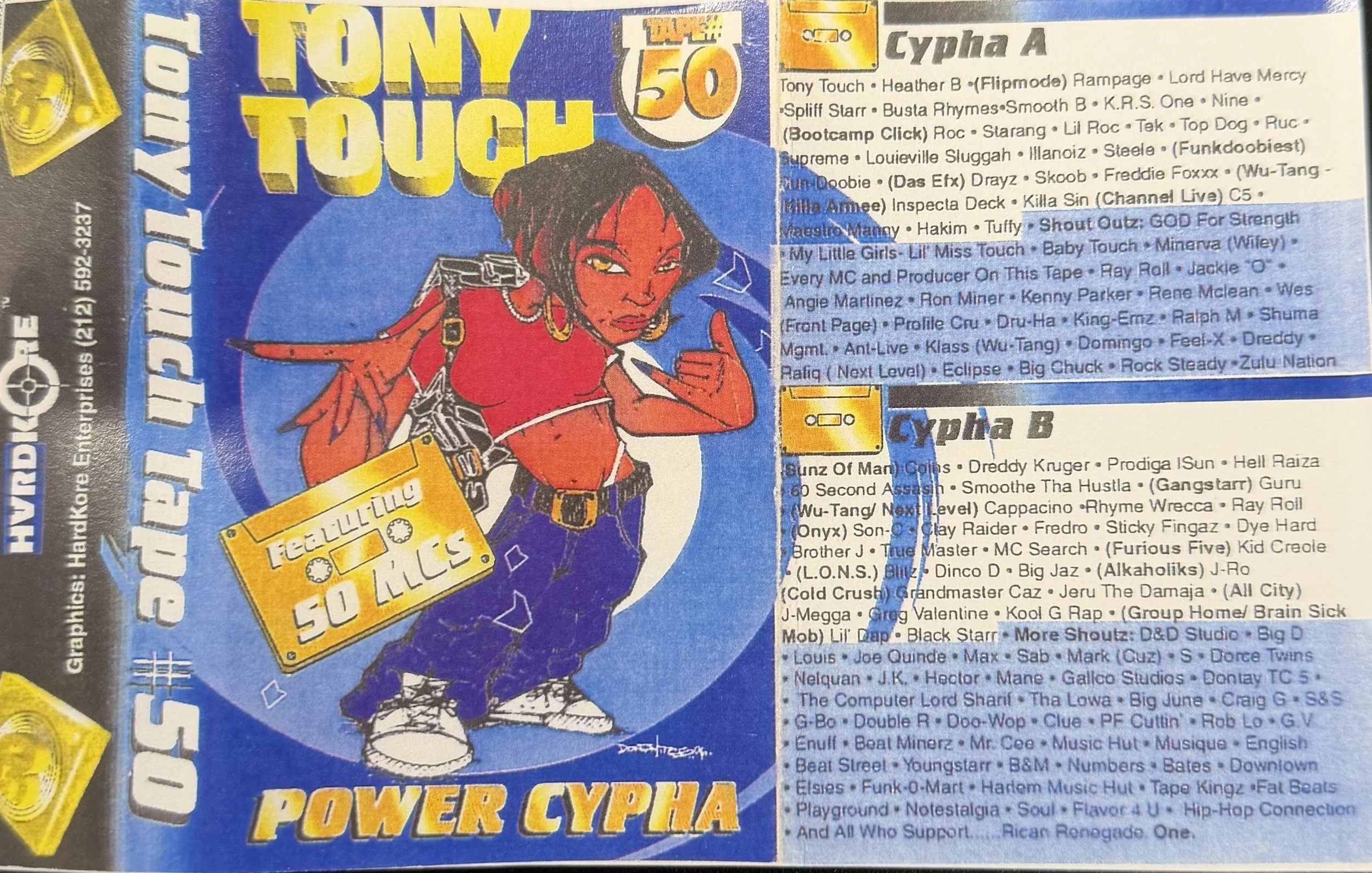
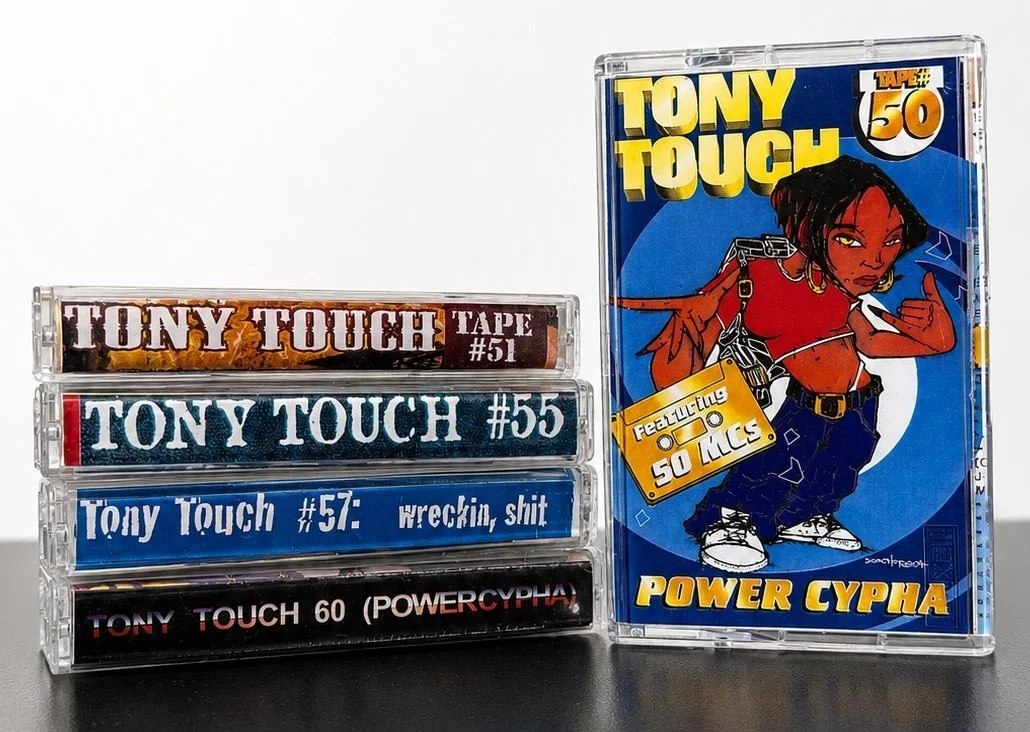
Released in 1996, Tape #50: Power Cypha did exactly what the title promised. Rather than assembling another mix of records, Tony Toca collected verse after verse from working MCs; some legends, some hungry newcomers, some in that dangerous middle zone where a great sixteen could change everything. Each one spitting over raw, hard loops, one after another, in a relay that ran the length of the tape.
The roster reads today like a census of mid-90s East Coast hip-hop. The Wu-Tang extended family showed up in a big way: Inspectah Deck, Killa Sin, and Sunz of Man. The Flipmode camp was there: Busta Rhymes, Rampage, Lord Have Mercy, Spliff Star. Boot Camp Clik sent all their soldiers. Das EFX, Onyx, Freddie Foxxx, Channel Live, Heather B, Smoothe Da Hustler, and Lil' Dap filled out the field. And in a move that says everything about Tony Touch's sense of lineage, old-school royalty appeared alongside the new blood, with Grandmaster Caz and Kid Creole, pioneers from the culture's first generation, spitting in the same cypher as the class of '96.
Were all fifty verses true off-the-dome freestyles? Of course not, and heads knew it even then. Inspectah Deck's contribution, famously, was an early airing of the verse that would later detonate on Wu-Tang's "Triumph," meaning tape collectors heard one of the most celebrated verses in hip-hop history on a Tony Touch cassette before the world heard it on Wu-Tang Forever. That kind of thing wasn't a flaw in the format. It was the format's superpower. The mixtape had become the place where material lived first.
Before Power Cypha, the mixtape economy ran on the DJ's ear: what records you had, how early you had them, how nasty your blends were. Tony Touch's innovation was to make the tape a site of original production: content that existed nowhere else because it was made for the tape. The exclusive freestyle had appeared on tapes before, but never as the entire organizing principle, and never at this scale.
This is the conceptual bridge to everything that followed. By the early 2000s, 50 Cent would weaponize the format entirely, using mixtapes of original material to build a movement that forced the industry's hand. The Diplomats, Lil Wayne's Dedication and Da Drought runs, Gangsta Grillz: the entire mixtape-as-album era rests on the premise Power Cypha proved: people will seek out a tape not for the records on it, but for the rapping on it.
There's a subtle power shift embedded in the concept. When fifty MCs record verses for your tape, the tape is no longer just your mix, it's your co-sign, distributed fifty ways. Appearing on a Tony Touch tape became a credential. For an unsigned or bubbling artist, a slot in the Power Cypha relay meant your voice sat in the same sequence as established rappers, in the Walkmans of exactly the tastemakers, A&Rs, and hardcore heads who could move your career.
Tony Touch understood the leverage. Power Cypha became a franchise: Tape #55 arrived in 1997 as Power Cypha 2, with another fifty MCs, and a third installment followed in 1999. And when Tony Touch made the jump to an official retail album with The Piece Maker in 2000, the whole project was essentially Power Cypha with clearances. The tape concept had become an album format.
Beyond the structural influence, there's the simple archival weight of the thing. 1996 New York was arguably one of the deepest talent pools any rap scene has ever produced, and Power Cypha caught an enormous cross-section of it in one uninterrupted document. Not the polished album versions of these artists, but the battle-ready, tape-deck versions. No hooks, no singles logic, no label sequencing. Just fifty voices over beats.
That's why the tape has aged into something closer to a primary source than a product. If you want to know what New York actually sounded like in 1996: the flows, the slang, the reference points, the sheer density of capable MCs, then Tape #50 is the field recording.
Trace the lineage forward and Power Cypha's DNA shows up everywhere. Tony Touch took a format built to showcase the DJ and turned it into the most important artist-development platform hip-hop would have for the next fifteen years. Tape #50 is where that turn happened. Fifty voices, one tape, and a culture rewired.
