
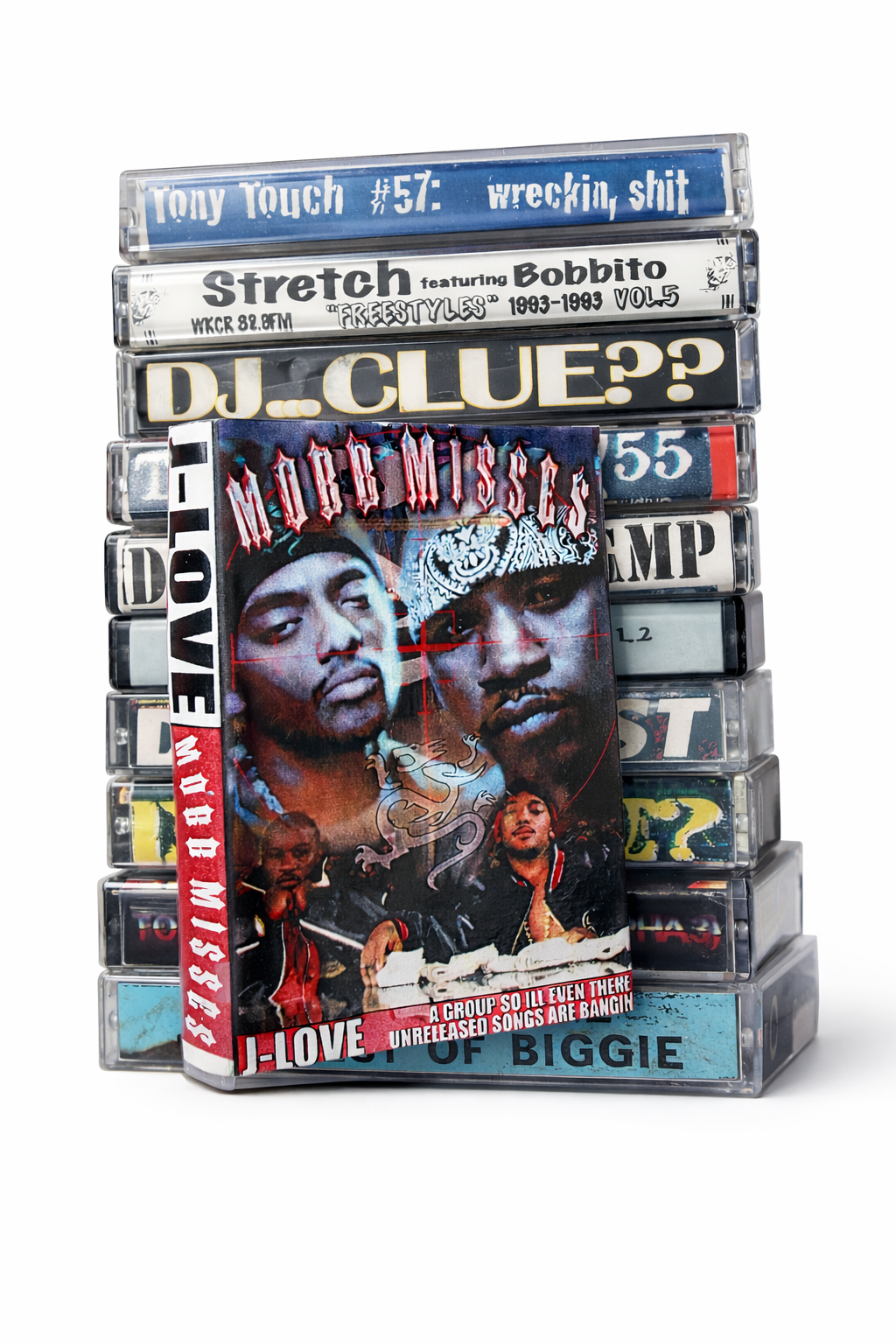
J-Love: Mobb Misses (1998)
Side A
Everyday Gunplay
We Got the Drop (feat. Big Noyd)
Crime Connection (feat. Cormega)
Street Life (feat. ACD)
Da Funk Mode (feat. Tragedy, Large Professor)
Reach
Take it in Blood
True Lies
Saga Ruff (feat. Cormega)
Where Do We Go (feat. Big Noyd, Tragedy)
Avirex
Duns & Kikos
QB Meets Southside (feat. Onyx, X1)
Cop Hell (feat. DJ Premier)
Side B
Pile Raps
Young Luv
In the Long Run (feat. Ty Nitty)
Rep the QBC
First Day of Spring (feat. Tragedy)
3 the Hard Way (feat. Big Noyd)
Hard Being Wifey Pt. 2 (feat. Cormega, Foxy Brown)
Stop Smilin’
It’s Alright with You (feat. Big Noyd)
Thrill Me (feat. Big Noyd)
Street Kings (feat. Nas)
Love Gets Stronger
Can’t F- with My… (feat. Half-a-Mil)
Perfect Plot
The brilliance of Mobb Misses isn’t simply that it collects unreleased Mobb Deep material; it’s that it challenges the assumption that an artist’s best work always lives on their albums. The subtitle on the tape says it plainly: “a group so ill, even their unreleased songs are banging.” After spending time with the tape, it’s hard to argue otherwise.
On its face, the line reads like mixtape bravado, the kind of hyperbole meant to stand out among the more recognizable DJs and titles lining record shop shelves. But the longer you sit with Mobb Misses, the more it feels like a measured claim. This isn’t a collection of scraps or filler. It’s a reminder that at their creative peak, Mobb Deep were operating at a level where even the material left off albums carried more weight, urgency, and street realism than what many artists were officially releasing at the time.
“Unreleased” often implies unfinished or disposable, but in Mobb Deep’s case, it usually meant something else entirely. Songs were left off albums not because they lacked quality, but because there simply wasn’t room. Album tracklists were finite; the group’s output wasn’t. The result is a catalog where some of the rawest, most uncompromising material exists just outside the official releases.
Prodigy’s 2012 autobiography, My Infamous Life, makes it clear that recording wasn’t an occasional event; it was routine. He describes a mindset rooted in constant creation: always writing, always in the studio, always looking for another verse or feature opportunity. That kind of work ethic doesn’t produce neat, album-sized outputs. It produces excess. Mobb Misses feels like a direct byproduct of that excess: a snapshot of how much material existed beyond what labels ever sanctioned.
You could even make the case that this tape holds its own against the Mobb’s official catalog from the same period. That may sound unfair at first. Albums come with expectations, even for a group as uncompromising as the M-O-B-B. Sequencing has to make sense. Songs need to flow. Singles must be identifiable. Verses get tightened, hooks emphasized, and rough edges smoothed out in the service of cohesion and marketability. None of that is inherently bad, but it does shape what ultimately makes the final cut.
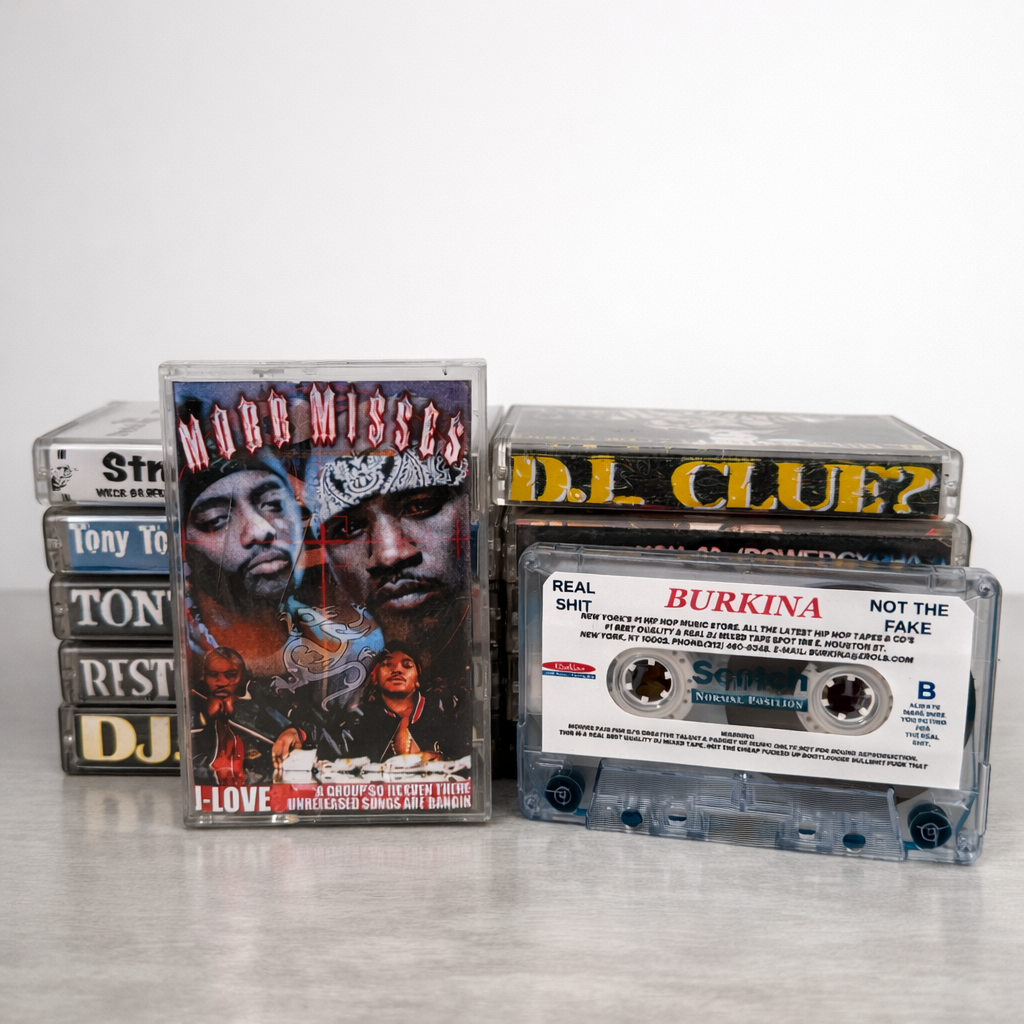
That’s where J-Love’s role becomes crucial. Mobb Misses doesn’t feel random or thrown together; it feels intentional. The sequencing favors mood over momentum, grime over gloss. Rather than chasing highlights, J-Love leans into atmosphere, allowing the tape to unfold like a darker, more volatile alternate history of Mobb Deep’s catalog.
There’s no concern for radio play here. No pressure to carve out a lead single. No obligation to balance street records with something more accessible. The songs don’t need to resolve cleanly or fit a narrative arc; they just need to hit. Because of that freedom, what comes through is a version of Mobb Deep that feels even darker and more instinctive, in all the right ways. In that sense, Mobb Misses doesn’t compete with the albums so much as it complements them, revealing what had to be left behind. And in some cases, what was left behind hits just as hard, if not harder.
Side A
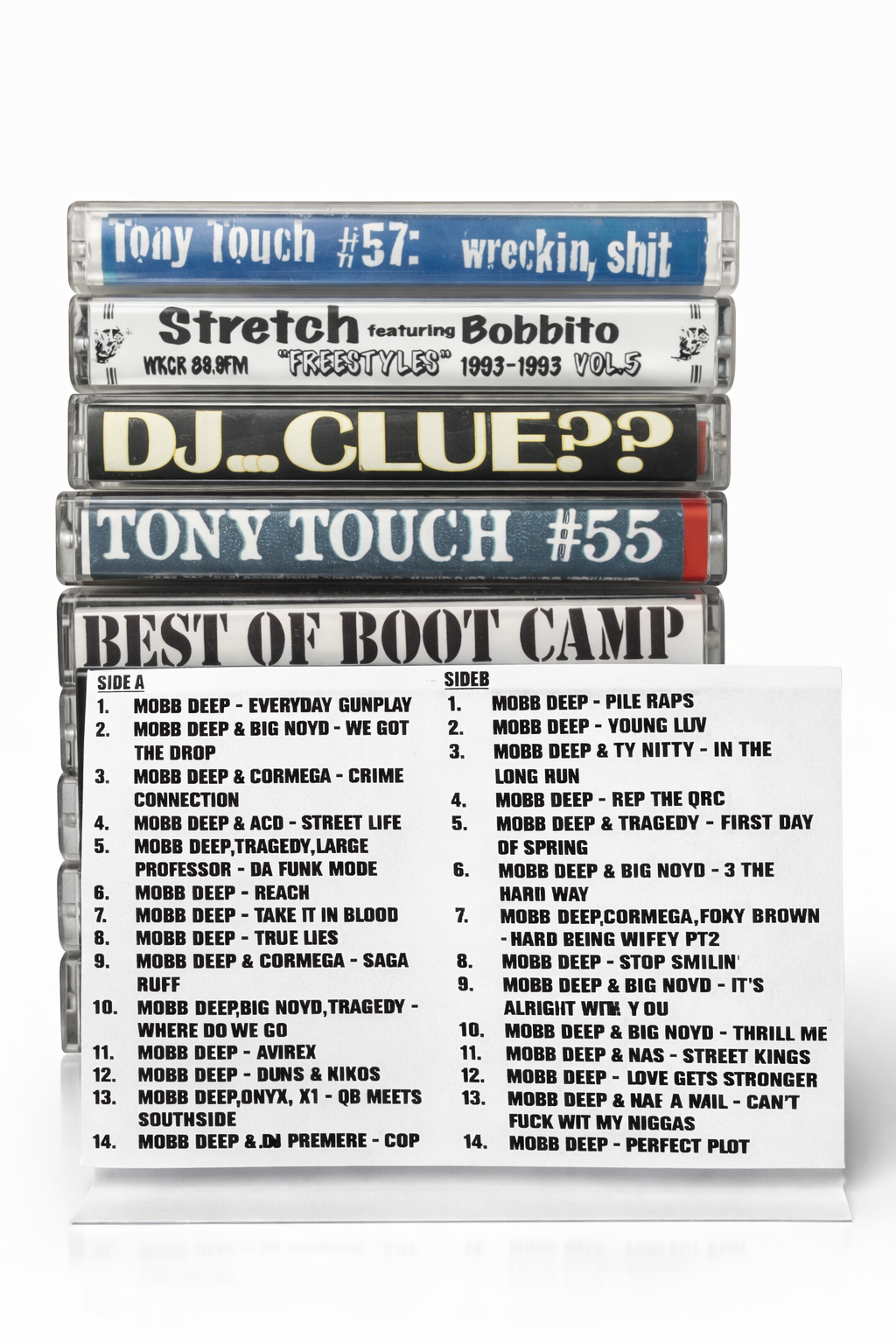
Right out of the gate, tracks like “We Got the Drop,” “Street Life,” and “Reach” make it impossible to dismiss this tape as a collection of leftovers. Sonically, these records live squarely in the same cold, oppressive atmosphere that defined Hell on Earth. The production is minimal but menacing: dusty drums, murky loops, and that unmistakable late-90s New York darkness where space and silence do as much work as the beats themselves.
The tone is set early on the tape’s second track, “We Got the Drop,” where Havoc lets it be known:
“The Mobb got it locked down, still heavyweights in this div-V-I
New … was shook, ain't it ill how we can read eyes?
No stoppin' this, it's approximate that you be coppin' this”
Later in the verse, the confidence sharpens:
“Rep the 41st side, I hold the title with pride…
No need to yell the name, we already established”
“Street Life,” featuring ACD, continues that thread. The beat is grimy and restrained, letting the vocals carry the weight. There’s a lived-in quality to the record — less polish, more presence — and it slots naturally alongside the darker cuts from Hell on Earth. Nothing about it feels out of place in that era, reinforcing how thin the line was between what became an official album cut and what ended up living on a mixtape (and later, on 1996’s America Is Dying Slowly compilation).
Taken together, these songs don’t just resemble Hell on Earth outtakes — they feel like they belong to the same creative moment. Their presence on Mobb Misses strengthens the argument that this tape isn’t documenting a step down in quality, but a parallel lane where some of Mobb Deep’s grimiest, most effective records were allowed to exist without constraint.
Side A closes with “QB Meets Southside,” an all-star posse cut bringing Mobb Deep together with their Queens neighbors from Southside Jamaica — Onyx. It’s a natural escalation point for the tape, uniting two of the most menacing groups of the era in an aggressive, unapologetically regional statement.
What makes the track work is the shared energy. This isn’t a strategic crossover or a label-engineered collaboration. It feels like an authentic Queens record, driven by proximity and mutual respect rather than commercial intent. Everyone sounds comfortable, locked into the same aggressive pocket, feeding off the raw intensity both camps were known for in the mid-90s.
Now let’s flip to the B-side…
Side B
“In the Long Run” stands apart from much of Mobb Misses by leaning even harder into menace. It’s still rooted in that same dark, late-90s New York atmosphere, but thematically it feels heavier. This is Prodigy delivering pure street reportage — unfiltered, confrontational, and unconcerned with consequence in the moment.
On the track, Prodigy alludes to incidents involving both 2Pac and Keith Murray, moments that would become infamous footnotes in hip-hop history.
The tension between Mobb Deep and 2Pac emerged during the mid-90s East Coast–West Coast era, fueled by the fallout from 2Pac’s 1994 shooting and robbery at Quad Studios. Comments made by Mobb Deep in subsequent interviews were interpreted by Pac as dismissive, escalating an already volatile situation. The conflict became cemented in rap lore when 2Pac called out Mobb Deep by name on “Hit ’Em Up.” Years later, Prodigy would reflect on the feud with greater nuance, acknowledging how youth, ego, and the climate of the time intensified what was ultimately a brief but lasting conflict.
On “In the Long Run,” however, Prodigy is firmly in battle mode:
“Got juiced up, now Bishop think he thuggin it
You get your little head pinched off
Brooklyn touched you, then left you for Queens to finish off”
The track also addresses his conflict with Keith Murray. Murray, who was known at the time for his “cosmic” vocabulary and science-heavy lyricism, reportedly took offense to Prodigy’s line about “crazy space shit that don't even make no sense” on “The Infamous Prelude.” That tension eventually led to an altercation between the two at the Tunnel nightclub. Prodigy recounts the incident in detail in his autobiography, describing both the confrontation and its lasting impact on his mindset.
Those same events surface bluntly in “In the Long Run”:
“Keith Murray and his whole clique
Yea, you snuffed me in front of the cops, that bullshit
Told you come around the corner, no police and no witnesses
Little to your knowledge, you almost got shot
But that's aiight though, I'm a catch ya ass again”
This is Prodigy processing real experiences in real time, without concern for how it would be received or contextualized later. That rawness reinforces the idea that mixtape records often captured truths that albums couldn’t, or wouldn’t, make space for.
In the end, Mobb Misses earns its own subtitle, showing that Mobb Deep were indeed a group so ill that even their unreleased songs didn’t just bang; they documented the era just as clearly as the albums did.
