
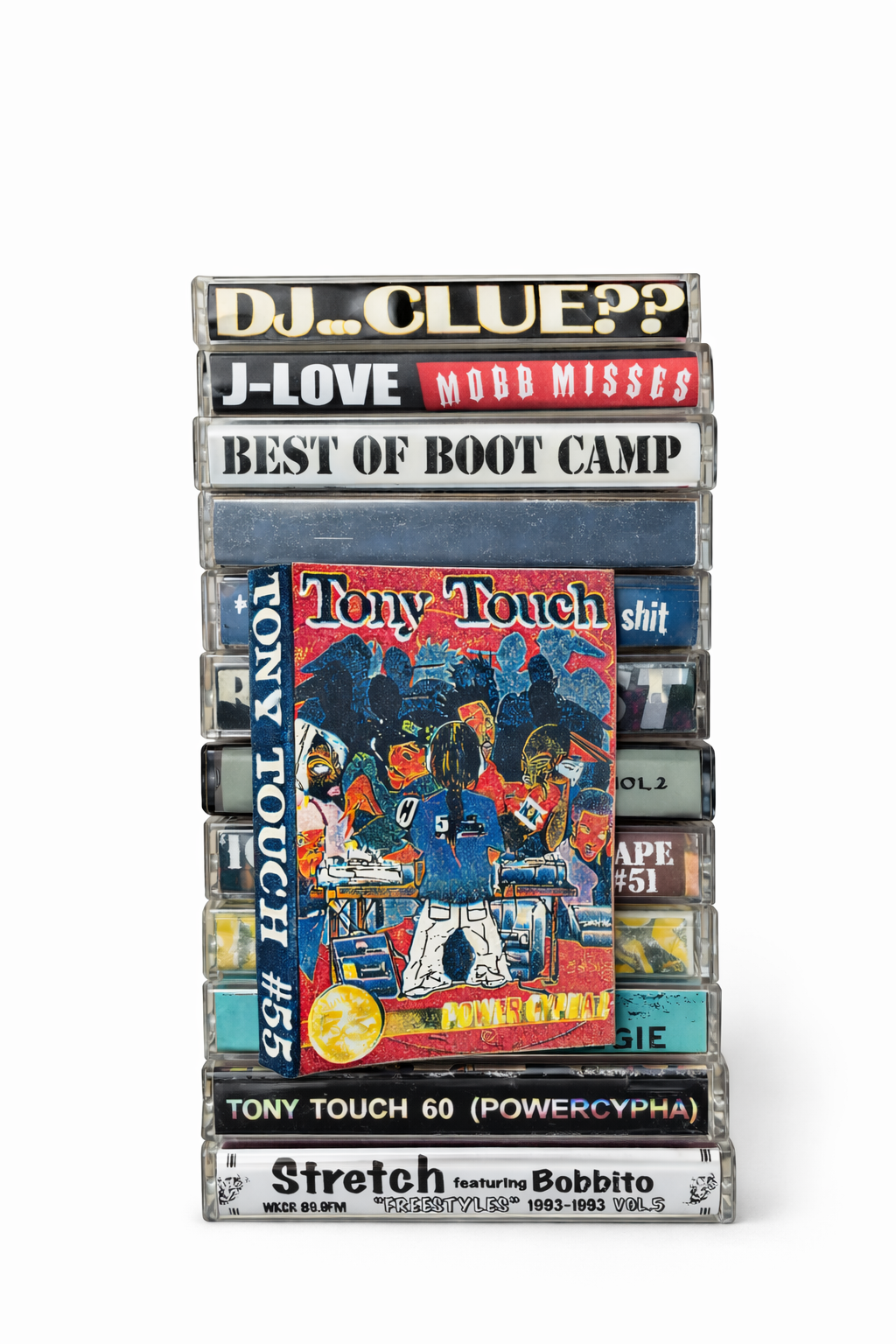
Tony Touch: #55 Power Cypha 2 (1997)
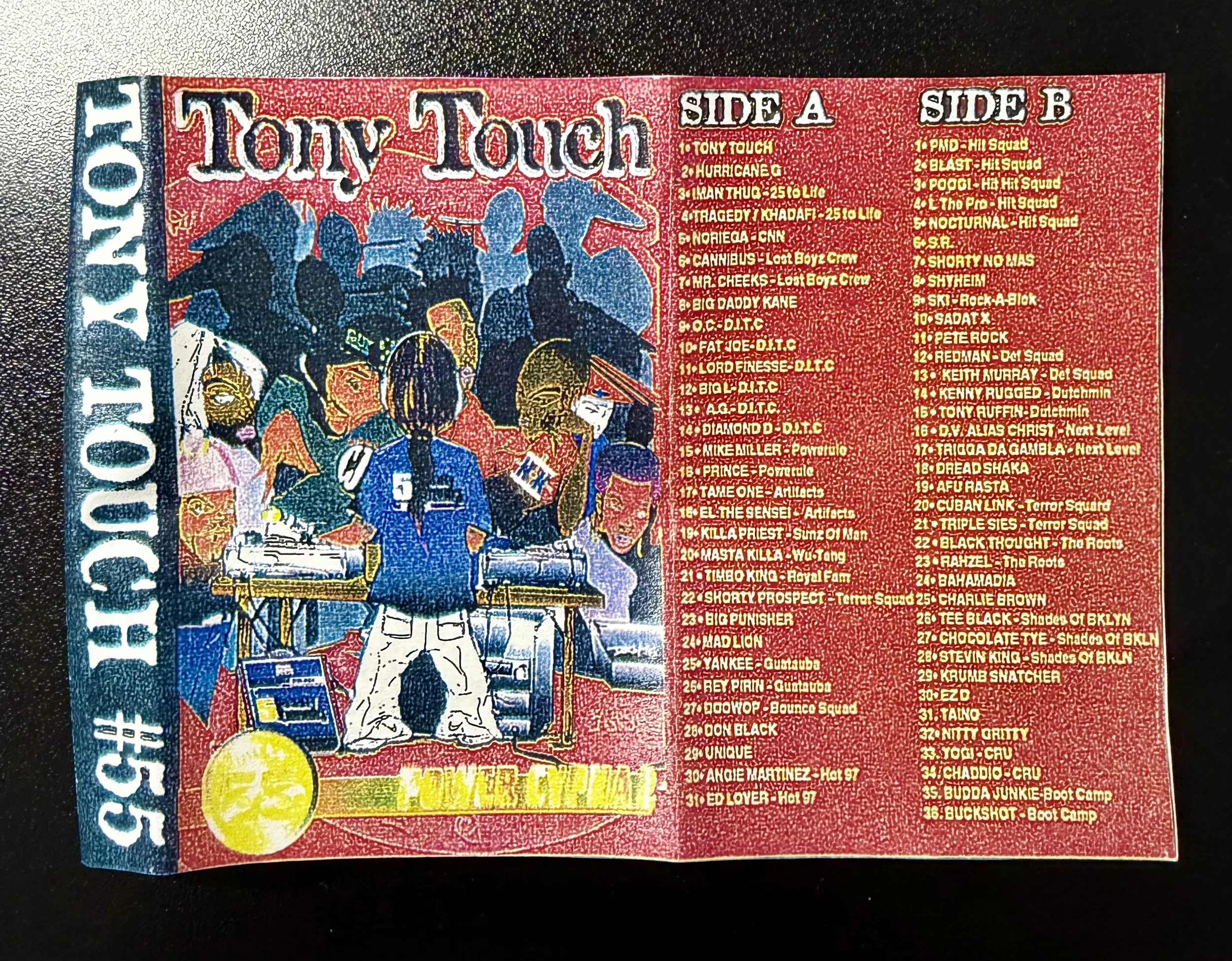
A-Side
Tony Touch
Hurricane G
Iman Thug
Tragedy Khadafi
Noreaga
Canibus
Mr. Cheeks
Big Daddy Kane
OC
Fat Joe
Lord Finesse
Big L
AG
Diamond D
Mike Miller
Prince
Tame One
El da Sensei
Killah Priest
Masta Killa
Timbo King
Shorty Prospect
Big Pun
Mad Lion
Yankee
Rey Pirin
Doo Wop
Don Black
Unique
Angie Martinez
Ed Lover
B-Side
PMD
Blast
Poogi
L the Pro
Nocturnal
SR
Shorty No Mas
Shyheim
Ski
Sadat X
Pete Rock
Redman
Keith Murray
Kenny Rugged
Tony Ruffin
DV alias Khrist
Trigga the Gambler
Dread Shaka
Afu Ra
Cuban Link
Triple Seis
Black Thought
Rahzel
Bahamadia
Charlie Brown
Tee Black
Chocolate Tye
Stevin King
Krumbsnatcha
EZD
Taino
Nitty Gritty
Yogi
Chaddio
Budda Junkie
Buckshot
In Do Remember! The Golden Era of NYC Hip-Hop Mixtapes, Tony Touch explains that the 50 MCs concept grew out of a desire to expand on the framework Doo Wop had established with 95 Live:
“Doo Wop was the first one to have multiple MCs on a cassette. He did 95 Live. It was groundbreaking … A year later, when I got up to my 50th mixtape, I wanted to try to take what he did to another level.”
This tape will always hold a special place in my heart, as it was the first entry in the 50 MCs trilogy that I heard. Tony Touch himself has also highlighted this volume as his favorite of the three:
“Out of all three of them, Volume 2 was probably my favorite one. The momentum was really strong off of the first one. I had a little more clout, so I was able to get a couple more big dogs on there.”
With such a deep lineup, there are naturally highs and lows on this tape. Let’s take a closer look.
A-Side
One of the first highlights for me on Side A is Tony Touch capturing Canibus at his arguable peak. In late 1997, mixtapes were still the proving ground for Canibus, and he sounded unstoppable.
By the time Canibus showed up on Tape #55, his reputation had already been built almost entirely on guest verses and mixtape freestyles, not singles or hooks. Tracks like Beasts from the East, where he famously delivers a 52-bar verse (arguably his most iconic) made it clear he wasn’t trying to make songs. He was trying to out-rap everyone.
Around this time, I was buying any tape with a Canibus freestyle on it. For a brief window (maybe a year?), he felt like the best rapper in the world to me. At that moment in hip-hop history, lines like “I know I ain't perfect, but I'm 99.9%,” calling other rappers “Micro soft like DOS,” or even boasting that he was “nice with the blah blah blah” felt fresh, clever, and genuinely new. You weren’t hearing everyone rap like that yet.
Here, Canibus leans into the dense internal rhyme schemes he was becoming known for, delivering another standout freestyle that only built more anticipation for his debut album, which would drop the following year:
“Can't battle me because I'll quadruple my brain capacity
The intellectual athlete accurately rappin' so rapidly
Yet, he makes perfect sense mathematically
I happily accept any rapper's offer to challenge me
50 emcees reduced to 49 casualties”
Ultimately, LL Cool J’s 4, 3, 2, 1 would drop a few months later in December, and we all know how that story unfolded. In hindsight, this freestyle captures a brief, perfect window when Canibus felt truly untouchable. Right before expectations, business decisions, and industry politics reshaped his narrative for good.
If Canibus represented hunger and ambition, then DITC represented authority. They were a reminder that some crews had already been setting the underground standard for years.
Tony Touch’s Tape #55 didn’t just document elite MCs; it highlighted how much the DJ mattered. By the late ’90s, Touch wasn’t simply compiling verses, he was directing moments, shaping how each rapper entered the tape and how their presence was felt.
That approach is evident throughout the DITC crew segment. Their appearance feels ceremonial rather than casual. By this point, Diggin’ in the Crates were already underground royalty, and Touch treats them as such.
The standout (no surprise here) is Big L. Even knowing that much of his verse had already appeared on O.C.’s Dangerous, the impact remains. Over the 10 Crack Commandments instrumental, Touch chops the Chuck D vocal sample to say “1–3–9” instead of the original ten-count, as a direct nod to 139th Street in Harlem, where L was from. The move reframes a familiar verse, turning it into something personal, intentional, and unmistakably his.
Now let’s flip to the B-side…
B-Side
And then there was Redman. No framing, no buildup, just confidence. You can hear it immediately: it’s clearly off the head. I’ve never been a stickler about written versus off-the-top freestyles, but in this context, it matters. On a tape this big, stacked with elite lyricists, many of whom were using writtens, Redman stepping in and really freestyling hits different.
It doesn’t sound sloppy or undercooked. It sounds loose, fearless, and fully in control, which only reinforces what made Redman special at that moment. On a project where polish and preparation were everywhere, his off-the-head energy stood out as its own kind of flex.
“Real freestyles aren’t just bars — they’re off the top of your head, and that’s what makes them so raw and dangerous.”
- Redman, on what defines a true freestyle
In the end, Tape #55: Power Cypha 2 wasn’t just a collection of freestyles. It was a document of a moment. When mixtapes were still how reputations were made. Hearing it now feels like hitting rewind on a brief window when hunger, craft, and spontaneity all collided.
